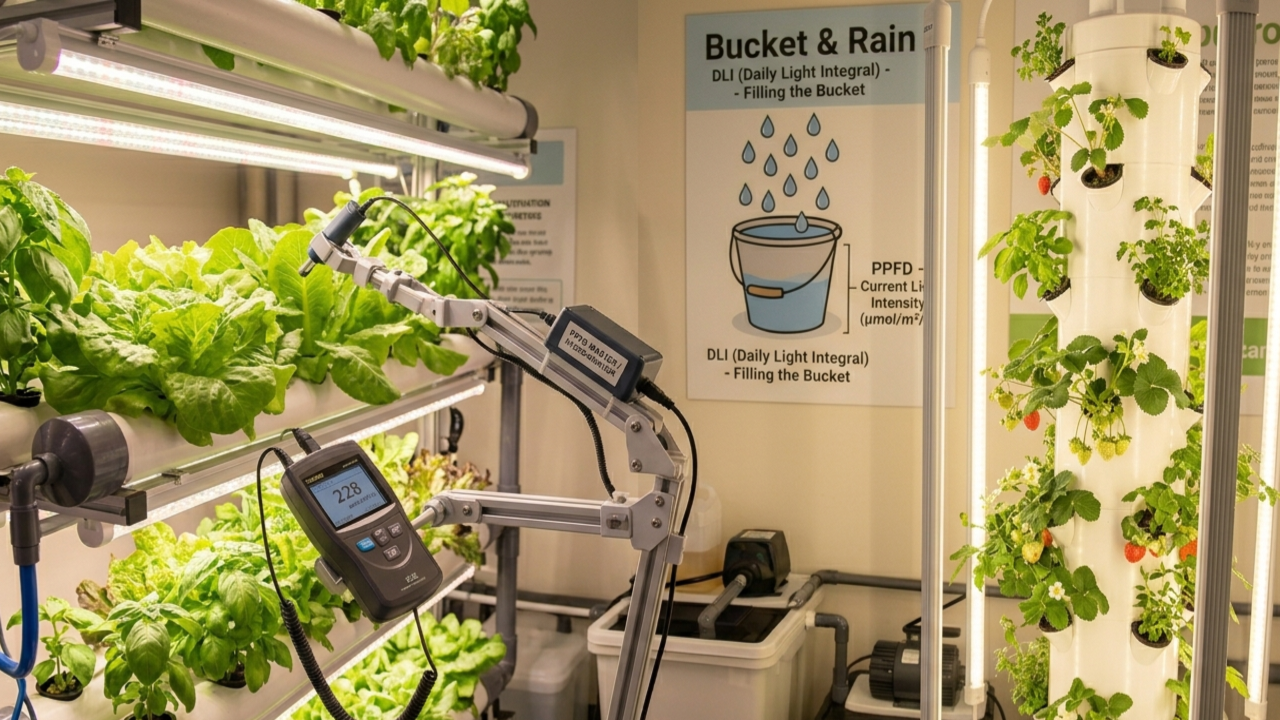
In hydroponics, we have eliminated the soil and brought everything under control, but one of the most crucial factors that often confuses beginners is light.
Many people look at "Watts" (power consumption) or "Lumens" (brightness for the human eye) when buying a grow light. But plants speak a different light language! They need a specific spectrum of light known as PAR (Photosynthetically Active Radiation).
To truly understand hydroponic lighting scientifically and precisely, you only need to know two simple concepts and one golden example:
1. Instantaneous Light Intensity (PPFD)
This metric shows how many "light particles" (photons) fall on a square meter of your plant's leaves every single second. (Unit: μmol/m²/s).
The Rain Example: Imagine PPFD as the intensity of rainfall right at this exact moment.
2. Daily Light Integral (DLI)
This metric shows the total amount of light your plant has received over a full day (e.g., during 16 hours of the lamp being turned on). (Unit: mol/m²/d).
The Rain Example: Imagine DLI as the total amount of water collected in a bucket by the end of the day. A plant needs a full bucket to thrive, not just a brief, heavy downpour!
Light Requirements for Different Plants (Exact Numbers)
Not all plants require the same amount of light. We can categorize greenhouse and hydroponic plants into 3 main groups:
Group 1: Leafy Greens and Herbs (Low to Medium Light)
These plants grow quickly, do not need to flower, and perform best under mild light. If the light is too intense, the leaves can burn or develop a bitter taste.
Examples: Lettuce, basil, spinach, mint, and microgreens.
Light Intensity (PPFD): Between 150 and 250 μmol/m²/s.
Daily Light (DLI): Between 12 and 17 mol/m²/d.
Light Hours: 14 to 16 hours a day.
Group 2: Fruiting Plants (Very High Light)
These plants require a powerful, simulated sun to generate enough energy for producing flowers and turning them into heavy fruits.
Examples: Tomatoes, cucumbers, bell peppers, and eggplants.
Light Intensity (PPFD): Between 400 and 800 μmol/m²/s.
Daily Light (DLI): Between 20 and 30 mol/m²/d.
Light Hours: 12 to 16 hours a day.
Group 3: Specialty and Bushy Plants (Medium to High Light)
This group sits right between leafy greens and heavy fruiting plants.
Examples: Strawberries and certain medicinal herbs.
Light Intensity (PPFD): Between 250 and 400 μmol/m²/s.
Daily Light (DLI): Between 15 and 20 mol/m²/d.
Light Hours: 14 to 16 hours a day.
A Golden Rule: Distance from Lamp to Plant
Light intensity (PPFD) drops drastically as you move away from the source (following the inverse-square law). If you double the distance between the lamp and the plant, the light reaching the leaf decreases by 4 times!
For standard LED Grow Lights: A distance of 30 to 45 cm from the plant canopy is usually ideal. If you notice your plants stretching upwards and becoming thin and weak (etiolation), it means the light intensity is too low and they are desperately reaching for the source. You need to move the lamp closer.