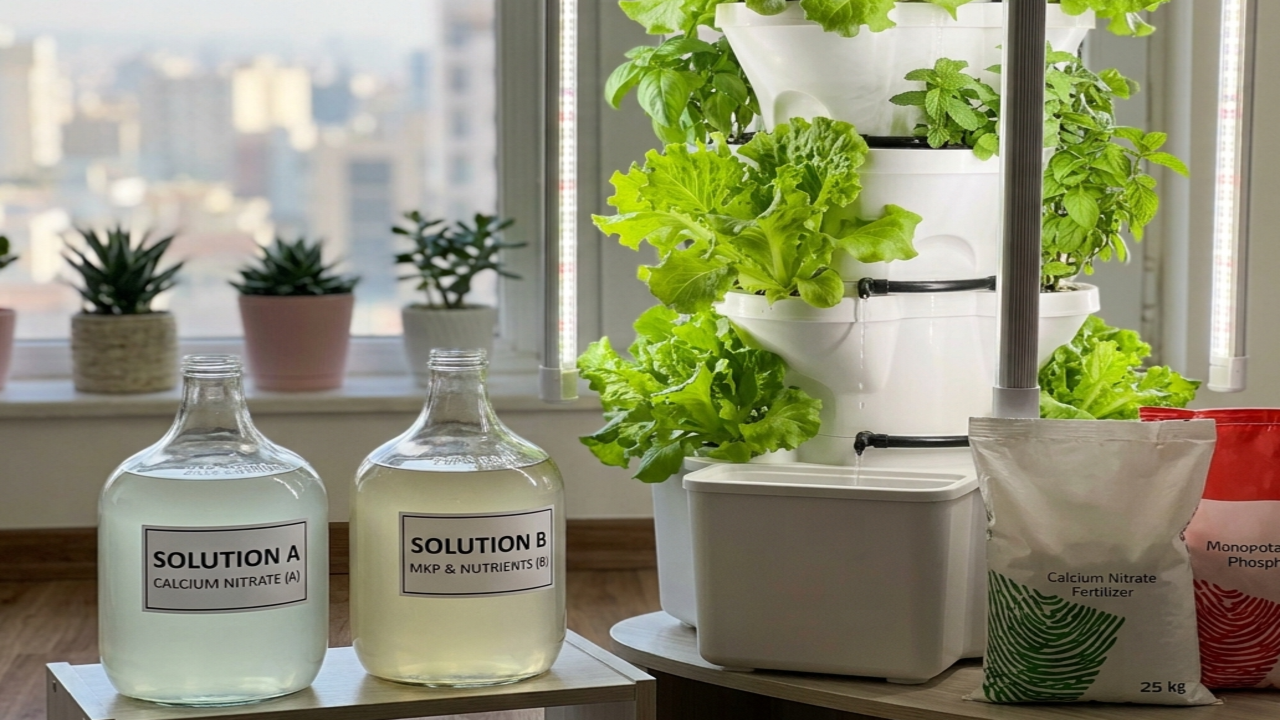
To get started, you don't need complex formulas. Simply purchase these three high-quality, essential fertilizers:
YaraTera Calcinit (Calcium Nitrate - White Bag): The primary source of nitrogen and calcium, vital for strong leaf and stem development.
YaraTera Krista MKP (Monopotassium Phosphate - Red Bag): Provides the necessary phosphorus and potassium for robust root establishment and flowering.
YaraTera Krista MgS (Magnesium Sulfate / Epsom Salt): Supplies magnesium and sulfur, which are critical for chlorophyll production and photosynthesis.
Step 2: Preparing the Stock Solutions (Solution A & B)
⚠️ Crucial Note: High concentrations of Calcium and Sulfate/Phosphate will chemically react, precipitate, and form an insoluble gypsum sludge that plant roots cannot absorb. To prevent this, we always prepare two separate concentrated stock solutions, labeled Solution A and Solution B.
Container 1 (Stock Solution A)
Pour 5 liters of water (purified, rainwater, or dechlorinated tap water) into a clean plastic jug.
Add 1 kg of YaraTera Calcinit (Calcium Nitrate) fertilizer.
Stir thoroughly until the solution is completely clear and fully dissolved.
Container 2 (Stock Solution B)
Pour 5 liters of water into a separate clean plastic jug.
Add 500 grams of YaraTera Krista MKP (Monopotassium Phosphate).
Add 500 grams of YaraTera Krista MgS (Magnesium Sulfate) to the same container.
Stir vigorously until all fertilizer particles are completely dissolved.
Step 3: Dosing into the "Plants Tower" Reservoir
Now you have two concentrated stock solutions. To feed your plants, you will add equal parts of each solution directly into your system's main water reservoir.
For a standard 100-liter water reservoir:
Fill the main reservoir with fresh water first.
Pour 50 mL of Solution A into the reservoir and stir well.
Pour 50 mL of Solution B into the reservoir and stir again.
Reminder: Never mix Solution A and Solution B together directly in a small bottle! Always dilute one into the main reservoir first, stir, and then add the second.
Step 4: Monitoring & Troubleshooting (How to Know It’s Right)
Plants will communicate their needs to you. To ensure your nutrient dose is optimal, follow these guidelines:
1. Using an EC Meter (The Scientific Approach)
If you own an EC (Electrical Conductivity) meter, measure the water after mixing the solutions. For most leafy greens and lettuce in a Plants Tower, your EC should read between 1.2 and 1.5 mS/cm.
2. Visual Plant Assessment (The Signs to Look For)
If you don't have a meter, keep a close eye on the foliage:
Signs of Under-feeding (Low EC): If the leaves turn pale yellow or growth stalls, the plants are hungry. Add a small, equal amount (e.g., 10 mL more) of both Solution A and B to the reservoir.
Signs of Over-feeding (High EC): If the tips or margins of the leaves look burnt and crispy brown, the nutrient concentration is too high. Immediately add some fresh water to the reservoir to dilute it.